
How to Boost Patient Satisfaction
It can be easy to lose sight of what’s most important, and that is patient care. Patient care isn’t just about diagnosing symptoms and filing paperwork. It’s about the patient’s satisfaction with their experience at their doctor’s office. Boosting patient satisfaction should be the core of everything you do in your practice. After all, where would we be without patients?

Think of it like going to Disney World. Disney World operates entirely by using a guest-centric approach. You won’t run into one cast or staff member who isn’t wholly devoted to making your Disney experience the best. This approach to guest satisfaction is no secret; it’s just about revolving the experience around the guest! And that approach can be directly applied to your physician’s office. Here are a few ways to improve the satisfaction of your patients today.
Assess The Here And Now
The first step to improving patient satisfaction is to assess their current satisfaction. Think of it as an experiment. Before reaching a conclusion, look a little deeper and ask some questions.
Anonymous patient satisfaction surveys are a great way to obtain patient feedback. You can administer surveys unobtrusively by asking patients to take the survey while waiting for the physician.
Make Patient Experience A Priority
Once you’ve found out how satisfied your patients are, it’s time to act. The healthcare field should solely be based on improving patients’ health.
Your patients’ focus needs to become a lifestyle–a living, breathing part of the practice. In other words, prioritizing patient experience is not enough; all other things must also revolve around it.
Best practices that your physicians can begin using right away:
- Use the patient’s names at least once during your conversation with them
- Explain to the patient what is going to happen next in each part of the visit
- Be attentive to the patient, and don’t interrupt or use a computer while speaking. This is where a virtual medical scribe can help!
- Look for cues that could indicate the patient is unsure of or unsatisfied with and respond accordingly
- Always respect patient-doctor confidentiality
- Please do what you say you will do when you say you’ll do it
Understand Your Patients
This is where the surveys also come in handy. Before you can start delivering excellent patient care, you first need to understand what your patients want, what they need, and what will make their experience positive. Understand which part of your patient’s journey drives satisfaction and which parts do not.
Three attributes to consider here are convenience, comfort, and service.
- Are your services convenient for your patients?
- Are your patients comfortable with your services and comfortable in your office?
- Is your practice providing the utmost service?
These are all questions to ask when devising a proper patient-experience plan.
Implement A Strategy
A cohesive strategy is a successful one. The entire practice must be involved in the conversation when deciding on improving patient satisfaction. In other words, no matter what measures you take to improve the lives of your patients, be sure that the entire staff is on board and involved. This could mean providing co-sourced help like prior authorizations, document indexing, or insurance eligibility verifications.
It’s also important to remember that the patient experience spans from the beginning to the end of their visit. This means that every aspect of your practice should be based on the patient, from the moment they walk in the door to the moment they leave.
Do you need help achieving a patient-centered approach? Let’s revisit the three attributes we mentioned: convenience, comfort, and service.
Convenience
Creating better convenience for your patients can also make the lives of your physicians a little easier. If you haven’t already, consider using text alerts to remind patients of their appointment time, with an option for patients to opt out of an appointment or reschedule if they can’t make it. This automatic text is both convenient and time-efficient.
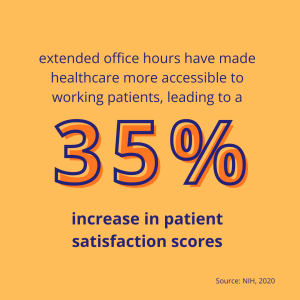
Convenience doesn’t have to be technical, however. Setting up a coffee machine or equipping your office with charging stations in the waiting room are ways to improve patient satisfaction through convenience. While its not always easy but extending office hours extended office hours have made healthcare more accessible to working patients, leading to a 35% increase in patient satisfaction scores (National Library of Medicine, 2022)
Arguably, the most significant inconvenience for patients is waiting too long for an appointment. If your office is running behind schedule or you think their appointment might start late, communicate that to the patient and even offer to move their time if necessary.
Comfort
Creating a comfortable atmosphere is the easiest way to boost patient satisfaction. A dirty, cramped office won’t elicit great feelings from your patients. Starting with the waiting room, ensure comfortable seating for your patients. Instead of metal chairs, cushioned chairs should give a homier feel. Televisions and magazines should be placed to pass the time, and for children, toys or games like easy-to-clean sensory walls are great to meet our post-pandemic standards. More so than ever post-pandemic, your goal should be to make the space comfortable in a safe and clean way.
Service
Patient satisfaction, though greatly affected by convenience and comfort, is influenced mainly by the quality of service a patient receives. It needs to be more than sending text reminders to patients or having iPads in the waiting room. Patients want to feel understood and cared for when visiting your practice.
As healthcare professionals, your patients should feel they can fully trust and rely on you. Listening to your patients is the easiest and most effective way to provide excellent service. As mentioned previously, instead of jotting down notes while patients are speaking, take the time to make eye contact and address their concerns. This makes patients feel they are being cared for, which is essential to patient satisfaction.
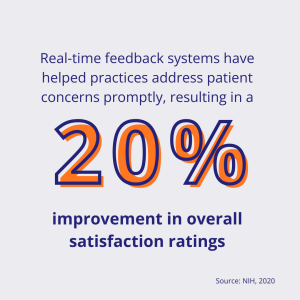
Once you’ve implemented a strategy to improve patient experience, it’s essential to maintain those efforts. Just like you initially allowed your patients to offer input through surveys, you should also let your patients give feedback once you’ve begun your strategy. Constant communication and patient feedback are essential. Real-time feedback systems have helped practices address patient concerns promptly, resulting in a 20% improvement in overall satisfaction ratings according to NIH, 2020
Outsource Services For More Time With Patients
A practice’s ability to maintain and retain patients has just about everything to do with the quality of the patient-provider relationship. However, with all the tasks required to provide excellent patient care, it’s easy to lose sight of that.
People want to be cared for by people. While caring for a patient’s health, it is essential that the patient feels cared for and understood. The majority of a physician’s time is spent typing symptoms and diagnoses into an EHR or EMR System, leaving little time for patient interaction. Outsourcing or co-sourcing your SOAP note and other administrative activities to a virtual scribe or remote medical transcriptionist will leave more time for quality patient care.
Additionally, partnering with a company that is fully compatible with your EHR system is equally important. Health records have gone from paper to electronic, and while this switch is meant to make things easier for physicians, not being fully integrated into your EHR system can end up hurting your practice. Take the time to find a partner that works with your current process and EHR instead of modifying your practice to fit their process. It will cost you more money and time and can keep many practices from getting to their end goal.
At DataMatrix Medical, we provide each physician with a team of medical transcription specialists trained to understand the intricacies of medical terminology and the dictation style of the physician they’re assigned to. We work flawlessly with whatever EHR your practice uses. We understand that most practices need many different ways to enter data.
To learn more about medical transcription services and how they can boost patient satisfaction in your practice, schedule a time to speak with one of our professionals today.

Nathaniel Smathers is the VP of Client Education and Marketing. He is also a long time contributor of the DataMatrix Medical blog and has a background in healthcare content creation for over a decade. Nathaniel is passionate about exploring the intersections of healthcare, data analysis, and digital innovation.