Administrative friction in healthcare rarely originates with a single dramatic failure. It builds quietly.
A prior authorization gets delayed because the supporting imaging was not uploaded. A coder returns a chart due to insufficient specificity. Staff spend time tracking down missing paperwork or re-dictating notes that cannot be located.
Individually, these feel like normal operational headaches.
Collectively, they signal a bigger problem: poor medical document management.
And in today’s reimbursement environment, disorganized documentation is not just inconvenient; it is expensive.
For orthopedic and dermatology practices, especially those with high procedural volume and increasing payer scrutiny, the documentation workflow is directly tied to revenue, denial rates, and staff morale. Even though AI-driven documentation tools can assist with note generation and summarization, they currently have clear limitations: they might fail to capture specialty-specific nuances, often miss payer-required elements for medical necessity, and frequently fail to structure the clinical details required for complex orthopedic surgeries or dermatologic procedures. Without manual review and structured document management processes, AI-generated documentation can omit necessary data such as conservative care history, lesion measurements, laterality, or step-therapy evidence. Such omissions are a leading cause of denials and delays.
To understand the impact, let’s break down the true cost of poor document management and explore practical solutions.
Why Poor Document Management Is More Than an Administrative Problem
Medical documentation is the backbone of coding, compliance, and reimbursement. When it is mismanaged, every downstream process slows, so we have to think about sorting and indexing in medical record management.
In orthopedics, that might mean delayed surgical authorizations because operative notes are incomplete or imaging reports are buried in scanned PDFs.
In dermatology, it might mean denials for biologics or excisions because documentation does not clearly establish medical necessity.
Poor document management affects:
- Prior authorization turnaround times
- Coding accuracy and specificity
- Denial rates
- Audit readiness
- Physician efficiency
- Patient experience
When documentation workflows are inconsistent or decentralized, staff compensate by manually handling tasks. And manual work in healthcare is almost always where cost increases. (preach)
7 Signs Your Medical Documentation Workflow Is Mismanaged
1. Your Staff Struggles to Locate Supporting Documentation
If your team spends more than five minutes locating clinical notes, imaging reports, or referral documentation for a prior authorization submission, that is not a small inefficiency; it is operational drag.
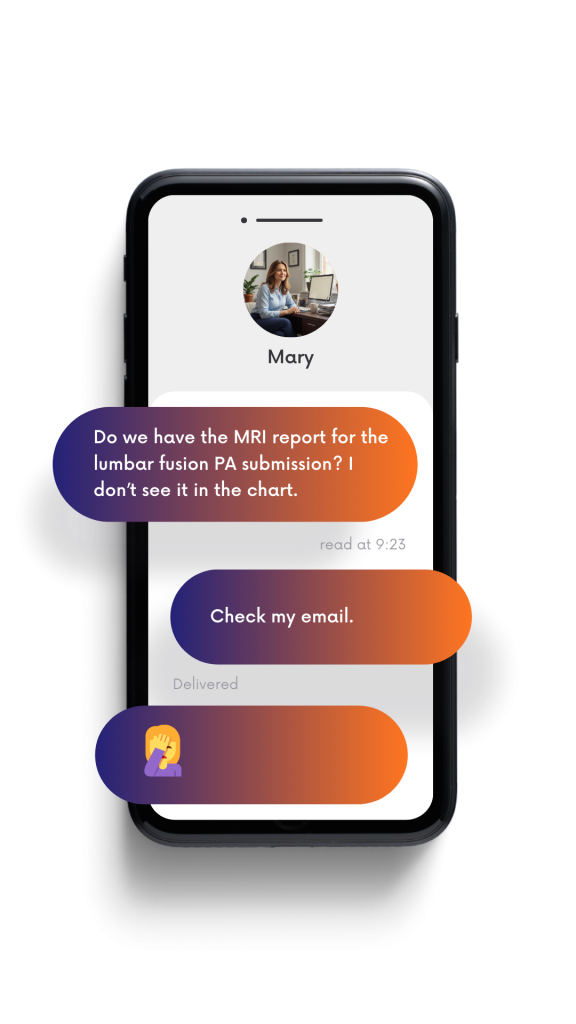
In orthopedics, MRI reports stored separately from clinical notes can result in incomplete prior authorization submissions and surgery delays.
In dermatology, poorly indexed pathology reports lead staff to scramble when payer documentation requests are made.
Lost time equals delayed revenue.
2. Prior Authorizations Are Frequently Delayed
Payers require:
- Detailed clinical notes
- Evidence of conservative treatment (in orthopedics)
- Photographic documentation (in dermatology, when applicable)
- Pathology confirmation
- Medication history
In real-world practice, this is where current AI-only documentation tools typically fall short. For example, an orthopedic patient being evaluated for spinal surgery may have months of conservative treatment logged across multiple visits. However, AI-generated summaries tend to solely highlight the most recent visit and may not systematically organize all relevant physical therapy attempts, prior injections, and medication trials in a structured way that meets payer criteria. The necessary information might exist, but if it is not properly collated for authorization review, the submission falls short.
In dermatology, consider a patient seeking approval for a biologic after failing topical therapies and systemic medications. An AI tool may summarize the encounter note, but current AI limitations mean that if step-therapy history is buried in narrative text and not clearly indexed or attached, the prior authorization submission is incomplete. As a result, the payer requests more documentation, even though the clinical story has already been documented.
If these documents are not organized, easily retrievable, and complete, the submission is incomplete. Incomplete submissions lead to:
- Pended requests
- Additional documentation requests
- Resubmissions
- Expired authorizations
This is certainly the case for prior authorizations in dermatology.
The issue is rarely “the payer.” In this case, it is often the documentation workflow.
If prior authorizations are slowing down because documentation packets are incomplete, disorganized, or difficult to defend, it may be time to look beyond internal fixes. DataMatrix provides dedicated Prior Authorization support that works alongside structured document management to ensure submissions are complete, properly attached, and defensible.
In addition to organizing and submitting required clinical documentation, our team records all payer calls and documents those interactions so they can be added directly to the EHR. That means when a denial occurs, your practice has a clear record of what was communicated, what was requested, and what was confirmed, strengthening appeals and reducing repeat disputes.
3. Coding Clarifications Are Increasing
When coders regularly send charts back to providers for clarification, documentation structure may be the root cause.
This statement is supported by PMC, which states that document structure and missing components lead to an increase in claim denials.
Let’s talk about a couple of specific medical specialties, such as orthopedics and dermatology.
Orthopedic documentation often requires specificity regarding:
- Laterality
- Severity
- Conservative treatment attempts
- Imaging confirmation
Dermatology documentation requires:
- Lesion size and location
- Method of removal
- Histopathology details
If these elements are inconsistently captured or buried within narrative notes, coding slows. And in turn, low coding delays claims submission.
4. Denials Cite “Insufficient Documentation.”
Few phrases are more frustrating to practice administrators than “insufficient documentation.”
This denial reason signals one of two things:
1. The documentation was incomplete.
2. The documentation existed but was not properly submitted.
Both trace back to document management processes.
For dermatology practices that prescribe specialty biologics, medical necessity documentation must clearly demonstrate prior therapy failure. If this is not documented or not included in the submission packet, denial is predictable.
For orthopedic injections or DME, a lack of conservative care documentation often leads to payer rejection.
5. Physicians Spend Extra Time Re-Documenting
When providers re-dictate notes or re-upload images because files cannot be found, burnout increases.
Orthopedic surgeons already face a high volume of documentation, including operative reports and follow-up care.
Dermatologists often document high daily patient counts with procedural detail.
When documentation systems fail, physicians absorb the inefficiency.
6. Compliance Reviews Feel Reactive
Audit readiness depends on structured documentation. We know this all too well, as we see it daily, and medical practices are just not ready for it.
If your team prepares for audits by manually gathering records across systems, scanning email attachments, and searching network folders, documentation management is fragmented.
Regardless of the medical specialty you are in, fragmentation increases risk.
7. Your Team Relies on Workarounds Instead of Systems
If staff say:
- “Check my email.”
- “It’s probably on the shared drive.”
- “I think billing has that.”
Your documentation workflow is not systematized.
When processes rely on memory, email threads, and shared drives instead of structured systems, inconsistency becomes the norm. Inconsistency slows submissions, increases rework, and quietly raises the risk of denial. At this point, the problem is no longer administrative — it is financial and clinical. And that leads directly to the next issue: how poor document management undermines medical coding accuracy.
Why Poor Document Management Impacts Medical Coding Accuracy
Medical coding depends on structured, complete documentation.
For example, in orthopedics, documentation must support:
- Specific diagnosis codes
- Surgical indications
- Imaging confirmation
- Treatment progression
Without complete documentation, coders may under-code to avoid compliance risk, not to mention a prior authorization challenge for orthopedic practices.
Undercoding quietly reduces revenue, which is why it is so dangerous. When documentation lacks specificity, coders often default to the safest defensible code rather than the most accurate and fully supported one. In orthopedics, that could mean reporting a less complex procedure because laterality, severity, or detailed operative findings were not clearly documented. In dermatology, it might mean selecting a lower-level E/M code because lesion characteristics, total body surface area involvement, or medical decision-making elements were not explicitly captured. The claim goes out. It gets paid. No denial appears. But the reimbursement does not reflect the full scope of care delivered. Over weeks and months, this gap compounds. For practices with high procedural volume, even small documentation deficiencies can translate into significant lost revenue. Unlike denials, which are visible and disruptive, undercoding quietly erodes financial performance while appearing compliant on the surface.
And let’s say that, in dermatology, documentation must establish the medical necessity of procedures and medications. Without specificity, coding is delayed or downgraded.
Documentation inefficiency leads to:
- Claim delays
- Rework
- Revenue leakage
How Disorganized Documentation Slows Prior Authorization
Prior authorization approvals hinge on documentation. Payers require clear clinical evidence that supports medical necessity, prior treatment history, imaging findings, and guideline alignment. That evidence must be organized, specific, and attached correctly at the time of submission.
When it is fragmented, buried in narrative notes, or missing key elements, approvals slow, additional documentation is requested, and avoidable delays follow. must be complete, clear, and properly attached.
When documentation is scattered, submissions are incomplete. When submissions are incomplete, turnaround slows.
Orthopedic example: A patient requires spinal surgery. Documentation must include failed conservative therapy, imaging, and detailed clinical findings. If one element is missing, the case stalls.
Dermatology example: A patient requires a specialty biologic. Documentation must demonstrate step therapy failure. If the medication history is not clearly documented, approval is delayed.
Documentation workflow drives authorization speed.
The Financial Impact of Documentation Inefficiencies
Poor document management affects revenue in four major ways:
1. Revenue Delays
Incomplete documentation delays submission and reimbursement.
2. Increased Denials
Missing documentation increases payer rejection rates.
3. Administrative Labor Costs
Staff time spent locating documents is a labor cost.
4. Patient Satisfaction Risk
Delays in care impact retention. And for practices with 4–10 providers, common among orthopedic and dermatology groups, these inefficiencies scale quickly.
How to Improve Medical Documentation Efficiency in Your Practice
Improvement requires structure.
1. Standardized documentation checklists by specialty.
2. Centralized document indexing.
3. Defined workflows for PA submissions.
4. Clear responsibility ownership.
5. EHR-integrated document management support.
When documentation is organized before submission, the risk of denial decreases.
Is Your Documentation Workflow Costing You Revenue?
Ask yourself:
- Are PAs delayed due to missing notes?
- Do coders frequently request clarification?
- Are denial rates unpredictable?
- Do physicians re-document information?
If yes, the documentation workflow likely needs restructuring.
How Structured Document Management Reduces Denials and Delays
Structured document management ensures:
- Documentation is indexed correctly.
- Supporting records are attached properly.
- Medical necessity elements are visible.
- Coding is supported by specificity.
For orthopedic and dermatology practices, this means faster approvals, cleaner claims, and less staff stress.
If documentation inefficiencies are slowing your practice, it may be time to evaluate your process.

Nathaniel Smathers is the VP of Client Education and Marketing. He is also a long time contributor of the DataMatrix Medical blog and has a background in healthcare content creation for over a decade. Nathaniel is passionate about exploring the intersections of healthcare, data analysis, and digital innovation.