We have long been captivated by innovation. From robotic surgery to artificial intelligence, it’s clear that automation is helping shape the future of care. But when it comes to clinical documentation, the best results don’t come from software clinical encoders alone. They come from a thoughtful balance in which automation accelerates processes and trained professionals ensure accuracy, nuance, and oversight.
When it comes to clinical documentation and coding, there’s a quiet but powerful force at work: people. Real humans. And companies like DataMatrix Medical are proving that human-powered services can be just as efficient and often more reliable than purely automated solutions.
Take, for example, a specialty orthopedic clinic we worked with last year. Their voice-to-text software generated pages of disorganized notes riddled with errors and lacking key billing terms. It looked fast on the surface but required hours of correction, often from physicians themselves. After partnering with DataMatrix, they adopted our scribe service, trained professionals working directly in their EHR. The result? Clean, billing-ready documentation with zero provider rework and a noticeable drop in claim denials.
In this blog, we’ll explore the strengths and limitations of clinical encoders, the unique role human experts play in EHR optimization, and why the future of medical practice management lies in a hybrid model where software accelerates. Humans ensure accuracy, context, and compliance.
What Are Clinical Encoders, and Why Do They Matter?
Clinical encoders are digital tools that convert medical terms, diagnoses, and procedures into standardized codes, such as ICD-10 and CPT. These codes are essential for billing, regulatory compliance, and healthcare analytics.
A Brief History: From Paper Charts to AI Promises
To appreciate where we are today, it helps to understand where we came from.
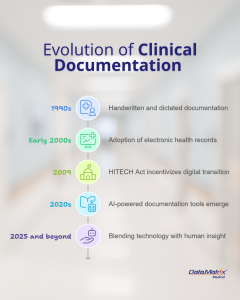
- In the 1990s, clinical documentation was almost entirely handwritten or dictated and then manually transcribed. Medical coders reviewed notes and translated diagnoses into ICD-9 codes, often relying on printed reference guides and institutional knowledge. Errors were common, but the human element ensured there was always someone available to interpret complex cases.
- By the early 2000s, the adoption of electronic health records (EHRs) had begun accelerating, especially after the HITECH Act of 2009 incentivized providers to transition to digital systems. With it came software-based encoders that could “suggest” codes based on typed or templated inputs. Practices were sold on speed and compliance, but they often encountered new challenges: rigid interfaces, context-insensitive recommendations, and higher-than-expected denial rates.
- Fast forward to the 2020s, and AI-powered documentation tools entered the scene, voice recognition, automated coding engines, and even AI medical dictation. While impressive, these tools often miss nuance, struggle with accents or complex terminology, and still require significant oversight.
- As we move ahead, it’s clear that technology has transformed documentation workflows, but the need for human insight has never been more pronounced. If anything, it has become more important to blend the best of both worlds.
The idea is simple: make documentation faster and billing more accurate. But the reality? Software-based clinical encoders often struggle with nuance. They can miss the clinical context or misinterpret provider shorthand. And when they do, the downstream effects can include denied claims, audit risks, and frustrated staff.
Enter the Human Encoder: A Living, Breathing Bridge
At DataMatrix Medical, we don’t just support clinical workflows—we live inside them. Our remote medical scribes, prior authorization experts, and transcription teams act as real-time interpreters of medical encounters.
Think of them as clinical encoders with empathy. Instead of relying solely on preset rules, they understand specialties, recognize when detail is critical, and ensure that information entered into the EHR tells the whole story.
When a medical practice relies only on preset rules or automated systems, it opens the door to costly blind spots. For instance, a software encoder might overlook a subtle modifier that changes a code from routine to complex, resulting in underbilling. Worse still, if a system misinterprets provider shorthand or fails to identify contradictions in documentation, it can result in denied claims, compliance flags, or even audit exposure. Without human oversight, these mistakes often go unchecked, resulting in significant financial and reputational fallout.
They don’t guess. They ask. They clarify. They catch inconsistencies before they become problems.
EHR Integration Is More Than Just Plug-and-Play
Software clinical encoders might boast EHR compatibility, but what good is that if they populate the wrong fields or misrepresent a diagnosis? Beyond functionality, there’s also the cost to consider. Many automation platforms charge steep setup fees, often ranging from $5,000 to $25,000, to get started. Monthly software licensing can run thousands more, depending on user volume and integration needs. And even after all that, practices are still responsible for troubleshooting, reviewing outputs, and correcting inevitable errors.
By contrast, DataMatrix Medical’s team works directly within systems such as athenahealth, ModMed, and others, without setup or integration fees. We offer hourly rates that are predictable, scalable, and tailored to your workflow. There are no hidden costs. No, IT overhauls. Just real human end-to-end medical coders embedded in your system from day one.
We know the workflows, the templates, and what billing teams actually need.
Our scribes and prior authorization specialists enter structured, billing-ready data with the same precision as software, but with the benefit of human oversight and clinical judgment. And yes, we integrate seamlessly. No downtime, no massive IT lift.
The Hidden Costs of Over-Automation
Here’s something many practices learn the hard way: automation without oversight can be expensive. AI-powered systems can make coding errors that go unnoticed until reimbursement is denied. Voice-to-text software can misinterpret terms, requiring time-consuming proofreading.
Consider the following real-world scenario: A large dermatology group has adopted a software-only documentation solution. It seemed cost-effective at first, but the system misapplied modifier codes on over 300 procedures within the first two months, resulting in underbilling and a loss of $78,000 in revenue. Worse, the practice didn’t discover the issue until payers began flagging inconsistencies, prompting a retroactive audit.
The financial burden didn’t stop there. Internal staff spent weeks sorting through past claims, and the group had to hire a coding consultant at $150 per hour to help correct and refile the documentation. Altogether, the incident cost the practice over $100,000, completely negating the software’s perceived savings.
In contrast, human-powered services from DataMatrix Medical deliver clean, accurate, and compliant documentation for the first time. Our teams reduce the burden on providers, freeing up hours each week that would otherwise be spent fixing what automation got wrong.
Why the Future is Human + Tech
We’re not anti-technology. In fact, we embrace it. But we believe the smartest path forward is a hybrid one: software for what it does best and humans for everything software can’t handle alone.
Take the case of a multi-location gastroenterology practice that integrated a leading AI-powered documentation platform across its provider network. The system promised hands-free note capture and coding accuracy. However, within six months, the practice began to notice increasing discrepancies in charge capture—specifically with complex procedures, such as endoscopic ultrasounds and EMRs. Upon investigation, they discovered hundreds of misclassified procedures and missing modifiers, resulting in nearly $200,000 in unclaimed revenue.
The issue wasn’t just about money. The staff morale dropped, coders were forced into reactive roles, and providers lost confidence in the system. Ultimately, they layered in human oversight, pairing DataMatrix Medical virtual assistant with their existing software, and the turnaround was immediate: cleaner documentation, improved cash flow, and restored trust across departments.
That’s the kind of impact hybrid systems can deliver when they’re managed with intention.
Clinical nuance. Judgment calls. Real-time provider support.
Our services, or services like ours, remain relevant in today’s AI arms race. We are a force multiplier for your practice, amplifying efficiency without compromising accuracy.
To Close
The race to automate in healthcare is understandable. But the goal shouldn’t be to replace people. It should be to empower them.
With DataMatrix Medical, you get more than a service. You get a partner who understands your EHR, your specialty, and your priorities. We don’t just interface with your systems; we become an extension of your team.
Ready to experience the power of human + tech? Let’s talk.
Want to see how human-powered support can streamline your workflow and reduce overhead? Schedule a consultation.

Nathaniel Smathers is the VP of Client Education and Marketing. He is also a long time contributor of the DataMatrix Medical blog and has a background in healthcare content creation for over a decade. Nathaniel is passionate about exploring the intersections of healthcare, data analysis, and digital innovation.