In a world where virtual connectivity has become the norm, it’s not just businesses adjusting to remote work—healthcare is, too. And while most of the attention focuses on productivity, access, and cost savings, another game-changing benefit is emerging from this shift: climate impact.
What was once seen as a fringe topic in healthcare administration, environmental sustainability, is quickly gaining traction. As Earth Day 2025 reminds us of our collective responsibility, the role of remote healthcare services, such as virtual scribing and outsourced administration, offers a powerful yet under-discussed opportunity to reduce the carbon footprint of healthcare.
The Cost of the Commute: Unveiling Healthcare’s Carbon Footprint
When we envision a medical practice bustling with activity, we often overlook the environmental costs of healthcare, focusing instead on the critical services it provides. But every white coat has a carbon shadow. The infrastructure of an on-site medical team, from the physical office space to the disposable masks, adds up to a substantial carbon footprint. However, the narrative shifts dramatically with the introduction of remote medical scribes and healthcare business process outsourcing (BPO).
Traditional Office Settings Writ Large
In traditional healthcare settings, every desk has its place, every piece of equipment has its socket, neatly packaged within the clinic or hospital confines. Physicians’ and staff’s automobiles contribute to environmental pollution with each visit, making up a nuanced yet undeniable section of healthcare’s more significant environmental impact.
Remote Medical Scribes and Outsourcing – The Silent Green Revolution
Remote medical scribes, working securely from another location, reduce the need for in-office personnel, driving down energy consumption and eliminating commute emissions. The same is true for outsourced support handling prior authorizations, referrals, and insurance verifications.
And it’s not just theory. Research published in PNAS shows that remote work can reduce the average carbon footprint of office-based roles by up to 58%, primarily due to reduced commuting, lower energy use, and a streamlined IT infrastructure.
Meanwhile, recent guidance from the National Library of Medicine emphasizes energy conservation as a critical path for hospitals and clinics to reduce emissions—think better insulation, smarter lighting, and yes, fewer people physically in the building.
Research Insights from PNAS.org
The PNAS research highlights that remote working in the U.S. can slash up to 58% of the carbon footprint typically associated with office-based roles. The findings underscore the underestimated environmental benefit of remote work setups, aligning with healthcare’s directive for a sustainable future. Below are two graphical representations of the research found on pnas.org.
This shows the variances in GHG emissions originating from five different sources, compared across remote, hybrid, and onsite workers:
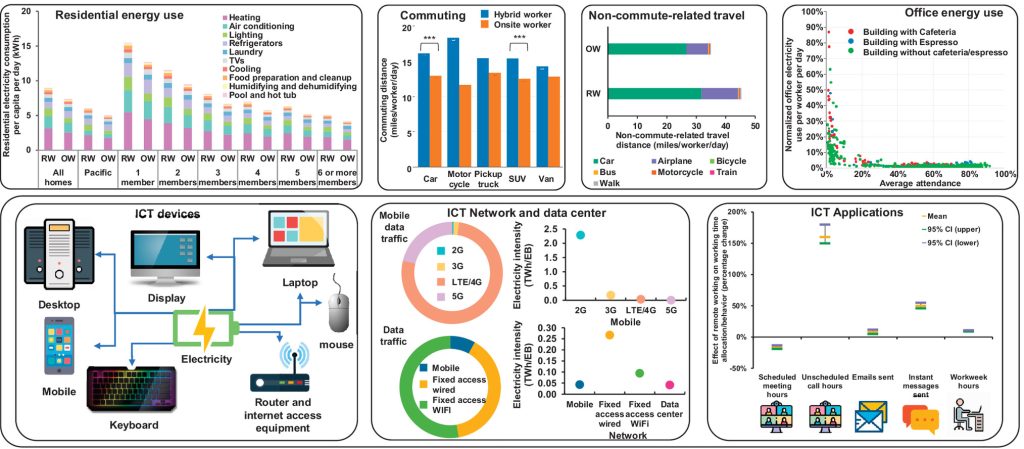
Methodology to investigate the climate change mitigation effects of remote and hybrid work in the United States. Residential energy use, non-commute-related travel, commuting, office energy use, and ICT services are included in the system boundary. Acronyms: natural gas (NG), remote work/remote worker (RW), onsite work/onsite worker (OW).
This graph shows the per-workday carbon footprint results of six different work settings (from fully remote to fully onsite):

Effect of remote and hybrid work on carbon footprint in the case of US Microsoft. (A–C) Show how transit type and trip origin and destination pairs differ by remote and onsite workers for non-commute-related travel. (D) Shows the variation in residential energy use. (E) Shows the breakdowns of carbon footprint for all six remote, hybrid, and onsite work scenarios. (F and G) Show the variation in household, workplace, and commuting GHG emissions for remote and onsite scenarios. Acronyms: remote work/remote worker (RW), onsite work/onsite worker (OW), combustion engine vehicle (ICEV).
Beyond the Carbon Footprint: Advantages of Remote Practice Management
Aside from the direct reductions in carbon emissions, remote practices boast additional benefits that align with the fight against climate change. A well-orchestrated shift to virtual teams contributes to increased employee satisfaction, potentially reducing staff turnover and solidifying a more sustainable operational model in more ways than one.
Don’t Forget AI’s Carbon Tab
While AI and automation tools are surging in popularity, their environmental cost often goes unmentioned. Generative AI models require substantial energy inputs to train and operate, a crucial consideration when comparing them to human-powered remote support solutions, which may offer a more sustainable alternative.
Making the Switch: Practical Considerations for Medical Practices
This exercise is not purely theoretical. Medical practices worldwide are contemplating or have already begun transitioning to remote operational models. From setting up secure communication protocols to ensuring data privacy, the shift is monumental but manageable.
Practical Moves for Medical Offices
This isn’t hypothetical. Medical practices today can take real steps:
-
Transition scribing and admin roles to remote formats
-
Conduct energy audits of their physical spaces
-
Choose outsourcing partners with green operations
-
Pursue sustainability certifications for operations
Strategizing for Sustainability
Taking this narrative one step further, medical practices that are already implementing remote virtual scribing and remote administrative support should begin credentialing and seeking recognition for their environmental stewardship efforts. Such certifications can attract environmentally conscious patients and contribute to the broader endorsement of remote healthcare solutions.
Remote Work in Healthcare – Reconciling Quality with Quantity
While the promise of remote healthcare services is laden with potential, the inescapable question remains: what about quality? Ensuring that remote medical services maintain and surpass the high standards of in-person care is a complex challenge that requires innovative thinking and unwavering commitment.
An All-Encompassing Solution: A Hybrid Approach to Remote Healthcare
The most compelling approach may not be to replace traditional healthcare with remote services entirely, but to develop a hybrid model that combines the best of both worlds while minimizing its carbon footprint. Such an equilibrium would foster a more elastic and environmentally attuned healthcare system.
Conclusion
Healthcare has long been about not harming. That principle can now extend beyond the body to the environment. By integrating remote roles and championing greener operations, medical professionals can lead the way in creating a healthier planet alongside healthier patients.
As Earth Day 2025 calls us to act, the opportunity is clear: go remote, go green, and go forward.

Nathaniel Smathers is the VP of Client Education and Marketing. He is also a long time contributor of the DataMatrix Medical blog and has a background in healthcare content creation for over a decade. Nathaniel is passionate about exploring the intersections of healthcare, data analysis, and digital innovation.