
When medical practices assess billing support partners, cost and claims processing functions often dominate the discussion. However, expertise in prior authorization is increasingly recognized as a key differentiator between high-performing and underperforming billing partnerships.
This article examines the importance of prioritizing billing partners with substantial expertise in prior authorization and analyzes how such partnerships directly influence revenue, scalability, and operational reliability.
Key Takeaways for Practice Leaders
- Prior authorization is a revenue protection function, not an administrative task.
PA sits upstream in the revenue cycle, but its impact is felt downstream in denials, cash flow, compliance risk, and patient experience. Treating PA as a strategic function reduces preventable revenue loss and operational disruption. - Billing accuracy alone cannot overcome poor prior authorization management.
Even perfectly coded claims will be denied if authorizations are missing, incorrect, or misaligned with payer rules. Effective PA workflows are essential to achieving low denial rates and predictable reimbursement. - Integrated PA and billing expertise creates measurable operational and financial gains.
Practices that align prior authorization with billing see fewer denials, faster reimbursement, reduced staff burnout, and greater scalability, without increasing headcount or administrative burden.
Understanding the role of prior authorization is the first step toward improving patient billing and a scalable revenue cycle.
The Disconnect Between Billing and Prior Authorization
During vendor evaluations, billing companies typically emphasize downstream processes such as coding, claims submission, payment posting, and follow-up. However, prior authorization occurs upstream and is frequently excluded from traditional billing scopes.
This disconnect results in operational gaps. When prior authorization is managed separately or inconsistently:
- Billing teams inherit preventable denials
- Claims staff must resolve issues they did not create
- Revenue becomes unpredictable
Decades of industry data indicate that an integrated approach effectively closes these gaps by aligning authorization, documentation, and billing workflows.
Why Billing Vendors Without PA Expertise Fall Short
- Billing vendors that lack PA specialization often:
- Rely on practices to supply authorization details
- Discover PA issues only after claim denial
Spend time appealing to avoidable denials
A Real-World Example: When Billing Teams Don’t Understand Prior Authorization
For example, a mid-sized cardiology practice may outsource medical billing while retaining prior authorizations in-house, assigning front-desk and scheduling staff to handle prior authorization requests as time permits.
The practice books a nuclear stress test for a Medicare Advantage patient. The billing team codes the service correctly and submits the claim once the procedure is completed. However, the billing vendor does not verify whether a prior authorization was required because PA is considered “outside their scope.”
Weeks later, the claim is denied not for coding or record-keeping errors, but because the prior authorization was either never obtained or submitted under the wrong benefit pathway.
What happens next:
- The billing team must flag the denial and send it back to the practice
- Front-desk staff scramble to reconstruct clinical documentation after the fact
- The payer denies the retroactive authorization request
- The claim moves to patient responsibility or is written off entirely
- Staff spend hours on follow-ups that do not generate revenue
From a leadership perspective, the billing vendor fulfilled its contractual obligations, yet the practice still experienced revenue loss. The underlying issue was not billing accuracy but rather insufficient upstream expertise in prior authorization.
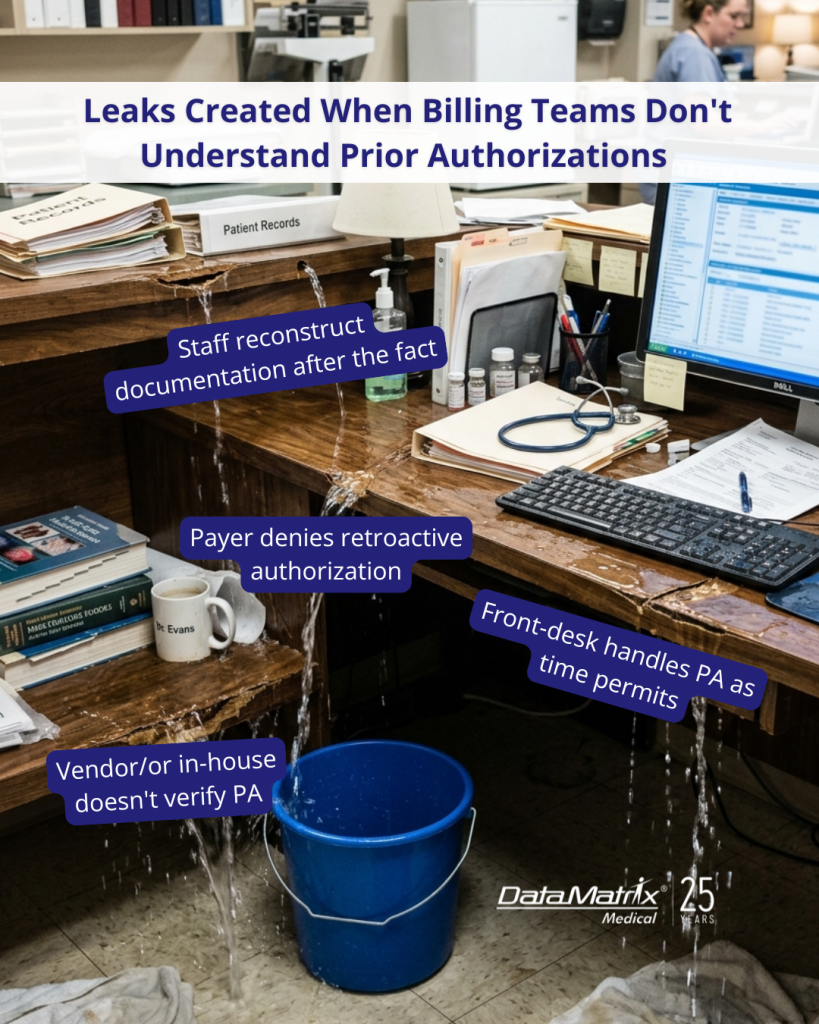
Such scenarios are prevalent in imaging, injections, outpatient surgeries, and specialty drug administration. When billing teams lack understanding of prior authorization requirements, denials become both inevitable and preventable.
This reactive model increases cost, delays reimbursement, and frustrates internal teams. Without PA expertise, billing accuracy alone cannot prevent revenue leakage.
The Competitive Advantage of Integrated PA and Billing Support
Partners specializing in both prior authorization and billing adopt a proactive approach. They understand payer rules before claim submission and ensure documentation is accurate from the outset. This assertion is supported by 25 years of experience in the healthcare industry.
This alignment leads to:
- Lower denial rates
- Faster reimbursement cycles
- Fewer appeals
- Better compliance posture
For leadership, this translates into predictable revenue and lowered operational risk.
This proactive alignment not only improves workflows but also directly impacts the two metrics most closely monitored by practice leaders: denial rates and cash flow. When prior authorization is managed correctly before claim submission, the financial impact is both measurable and immediate.
Impact on Denial Rates and Cash Flow
Denials due to authorization errors are among the most preventable and costly. Specialized PA support dramatically reduces these denials by ensuring approvals are secured and documented correctly.
Lower denial rates improve:
- Days in accounts receivable
- Cash flow forecasting
- Overall revenue consistency
Although robust authorization workflows protect revenue, their benefits extend beyond financial outcomes. Reduced denials and expedited reimbursement alleviate pressure on internal teams, influencing staffing, scalability, and operational sustainability.
Staff Relief and Operational Scalability
Practices commonly struggle with staff capacity. PA work is time-intensive and mentally taxing, contributing to strain and turnover.
A billing partner with PA specialization:
- Reduces internal workload
- Supports fluctuating volumes
- Allows practices to scale without hiring
This reduction in workload enhances staff morale and retention, while supporting continuity of care.
Specialty-Specific PA Expertise, Technology, and Workflow Alignment
Prior authorization requirements vary widely by specialty. Orthopedics, cardiology, radiology, ophthalmology, dermatology, ENT, and pediatrics all confront unique authorization rules, documentation thresholds, and payer expectations.
When billing partners lack specialty-specific PA knowledge, delays and denials increase. In contrast, specialized partners bring a combined advantage:
- Familiarity with procedure- and specialty-specific PA rule
- Deep experience with payer nuances across service lines
- Faster turnaround times that keep patient scheduling on track
Equally important is operationalizing this expertise. While practices may be concerned about integration complexity, an effective partner adapts to existing systems rather than imposing disruptive workflow changes and is an IT-friendly provider of prior authorization solutions.
Key capabilities include:
- EHR-agnostic processes that work within current systems
- Flexible submission techniques aligned to payer requirements
- Clear reporting and visibility across authorizations and billing
Combined specialty expertise and workflow flexibility minimize disruption and delays, fostering a more predictable operating environment and enabling clearer evaluation of performance and value.
This is where the conversation smoothly shifts from operational improvements to outcomes: measuring ROI past cost per claim.
Measuring ROI Above Cost Per Claim
Evaluating billing partners solely on price overlooks broader considerations. Comprehensive return on investment includes:
- Reduced denials
- Faster approvals
- Lower staff overtime
- Elevated patient experience
Integrated prior authorization in medical billing support regularly outperforms fragmented models when measured holistically.
Overcoming Common Barriers to Outsourcing PA and Billing Together
Common concerns include execution complexity, cost justification, and measurement of return on investment. These concerns are valid, particularly for practices that are already overextended, but they can be addressed with the appropriate partner.
This is where DataMatrix Medical provides direct, proven solutions:
Implementation difficulty: DataMatrix offers streamlined onboarding with minimal interruption. Our teams are EHR-agnostic, adapt to your present workflows, and typically complete implementation with a simple kick-off and training call, often in a single day.
Cost justification: By delivering over 50% cost savings compared to in-house staffing and significantly lower denial rates (less than 1%), DataMatrix helps practices clearly connect operational improvements to monetary results.
ROI measurement: DataMatrix provides transparent performance measures, including authorization turnaround times, approval rates, and denial trends, permitting leaders to measure success beyond cost per claim.
Scaling without strain: Our scalable staffing model allows practices to handle fluctuating PA and billing volumes without hiring, retraining, or overloading internal teams.
By integrating specialized prior authorization expertise into billing and revenue-cycle support, clinics often achieve measurable value more rapidly than anticipated, without increasing complexity or risk.
What to Look for in a Specialized Billing Partner
When evaluating partners, look for:
- Proven PA expertise
- Specialty experience
- Strong compliance controls
- Concise communication and reporting
- Flexible, scalable engagement models
Selecting a partner with expertise in both authorization and billing positions a practice for sustained success.
Final Thoughts
Prior authorization and medical billing are inseparable in the current healthcare environment. Practices that align these functions under specialized support achieve greater efficiency, predictability, and operational assurance.
For leaders focused on reducing denials, supporting staff, and protecting revenue, selecting a billing partner with deep PA expertise is a tactical benefit.

Nathaniel Smathers is the VP of Client Education and Marketing. He is also a long time contributor of the DataMatrix Medical blog and has a background in healthcare content creation for over a decade. Nathaniel is passionate about exploring the intersections of healthcare, data analysis, and digital innovation.