Your time is your most valuable resource, and you must use it wisely. This is particularly true if you work in a hospital, in your own medical practice, or otherwise operate in a direct patient care role. You probably want to maximize the amount of time you spend with your patients, and a medical scribe can help you do so. To be clear, this article is about trained human medical scribes, not AI medical scribes. At the same time, there is a place for AI, not in this discussion. We will cover what medical scribes are, what medical scribes are NOT, and some of the top benefits of medical scribes for providers.
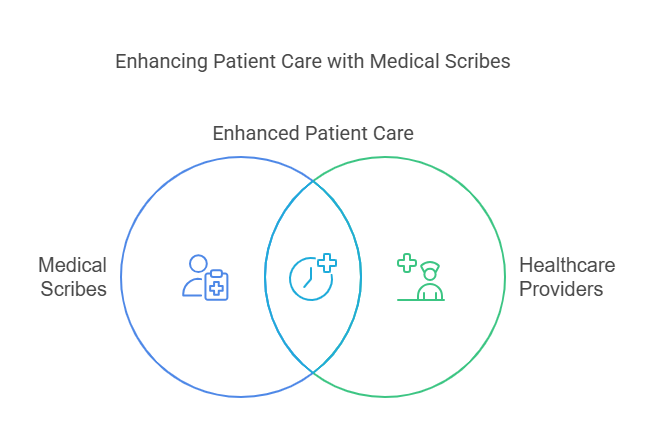
An Overview of Medical Scribes
1. Improved Provider to Patient Engagement
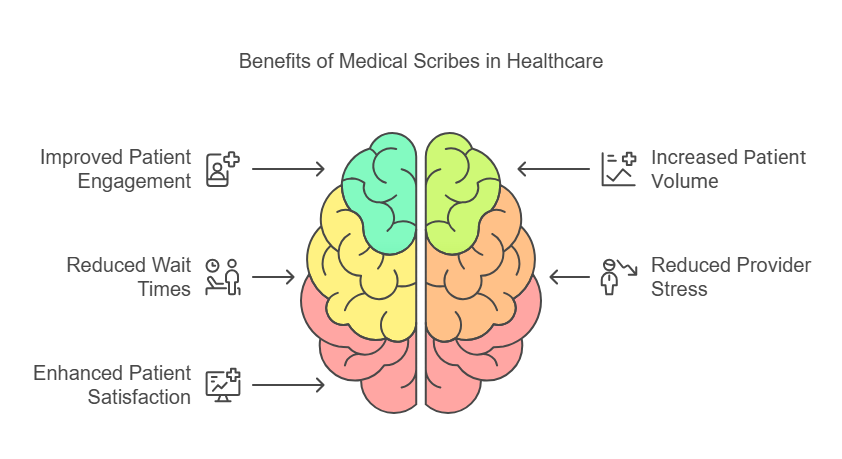
One of the biggest benefits of working with a medical scribe is that it allows the provider to see more patients and deliver higher-quality care. The provider can conduct the exam without being hidden behind a computer screen and can read the patient’s emotions and respond accordingly. If a medical scribe takes notes during your visit, you can focus all your attention on patient care. This can increase patient satisfaction and in turn generate more patient referrals, which will create more revenue opportunities.
2. See More Patients in a Day
If you work with a medical scribe, you can see more patients in a day. Because you can spend less time charting, you can spend more time seeing patients. Even if a medical scribe saves you only 3 minutes per visit, that adds up over 20 or 30 patients. You may be able to see a few extra patients every day, which can generate more revenue for your practice.
3. Shorten Wait Times
If you use a medical scribe, you can also shorten wait times. According to PatientPractice.com, you should be aiming for the fewer-than-10-minute mark, as far as to wait in the waiting room, and then less than 20 minutes from the time the patient is placed in the exam room until they see the doctor/practitioner (not the nurse/tech.) One reason a patient spends a lot of time waiting is that providers chart between visits. If providers don’t have to fill out the chart at the end of the visit, they can immediately move on to the next patient. This can shorten wait times, and it could allow additional slots for walk-in visits.
 4. Reduced Provider Stress
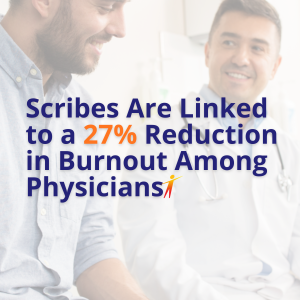
Using a medical scribe or in some cases can also significantly reduce the stress placed on providers. So how does a medical scribe help a physician? A medical scribe has the training necessary to chart the visit accurately, which could improve billing and coding accuracy. This is one less issue that providers have to worry about. Furthermore, providers don’t have to rush through the charting process at the end of the visit because it will already be taken care of. Doctors are under a tremendous amount of stress today, and a medical scribe can take some of this stress off of their shoulders.
5. Better Patient Satisfaction
Finally, working with a medical scribe can also significantly improve patient satisfaction rates. The reality is that patients are happier if they can interact with their providers face-to-face during the visit. If patients feel their providers are paying full attention to them, they are more likely to be satisfied with the visit and to return to that practice in the future. If patients feel like the provider is focusing on the computer screen instead of on them, they are less likely to be satisfied with the appointment. Providers need to work with a human medical scribe to improve patient satisfaction rates.
You now might be asking yourself, what about direct hire medical scribe vs remote medical scribe? Well thats for another topic. Now we are going to talk about what a medical scribe is not.
What a Medical Scribe is NOT (And Why That Matters)
Medical scribes are one of the most useful tools in modern healthcare, but let’s clear up a few things. They’re not superheroes (though they free up a doctor’s time like one), and they’re not just glorified note-takers. There’s a lot of confusion about what scribes do—and, more importantly, what they don’t do. So, let’s break it down.
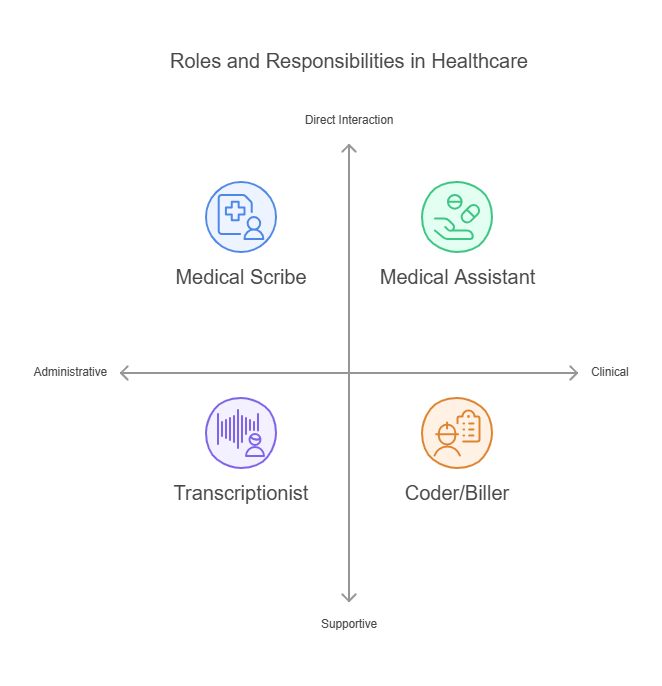
1. A Medical Scribe is NOT a Medical Assistant or Nurse
Medical assistants and nurses keep clinics running by checking vital signs, administering medications, and preparing patients. Scribes? They don’t do any of that. No blood pressure cuffs, no injections, and absolutely no “Can you hold still for just one second?” moments.
Instead, scribes document every symptom, treatment plan, and back-and-forth between doctor and patient. They ensure that medical records are complete and accurate while the clinical staff focuses on patient care. A nurse can’t be in two places at once, and that’s where scribes make a real impact.
2. A Medical Scribe is NOT a Transcriptionist
If you picture a scribe sitting in a dark room, typing up a physician’s recorded notes hours after the patient has left, think again. Medical scribes work live in the exam room (or remotely in real-time), capturing conversations as they happen.
Transcriptionists work off recordings, typing word-for-word. Scribes, on the other hand, structure notes properly, so when a provider looks back at a patient’s chart, it actually makes sense. No long-winded, jumbled dictations. No half-finished thoughts. Just clear, usable documentation. Now, that is not to say medical transcription is not useful is certain situations. Learn more about our medical transcription services.
3. A Medical Scribe is NOT a Coder or Biller
Yes, scribes help doctors document everything needed for accurate coding and billing. But they don’t actually assign the codes or process insurance claims.
Think of it like cooking. The provider picks the ingredients (symptoms, treatments, diagnoses), and the coder turns it into a final dish (insurance-ready claims). The scribe? They’re the sous chef, ensuring everything is prepped, measured, and ready to go—so nothing gets missed or thrown out.
If billing is what you need, check out this article on how to improve medical billing processes.
4. A Medical Scribe is NOT a Virtual Assistant or Chatbot
Artificial intelligence is improving, but let’s be real—it’s not replacing human scribes anytime soon, or at least it should not. Sure, AI can generate notes, but it can’t adapt to the nuances of a conversation. It won’t pick up on a doctor’s shorthand, inside jokes, or the sigh that means, “I need to rephrase that before it goes in the record.” As a scrbing provider for 25 plus years, we have seen so many situations where a practice is using an AI scribe for encounters, but are so bad they have to be edited and cleaned up by either the staff or trained scribes like us. What a waste.
A scribe works alongside the doctor (in person or remotely), learning their preferences and workflow. They get better over time, just like a well-trained employee—because that’s exactly what they are.
NOTE: There is an AI arms race in healthcare. Learn more about medical transcription ai and ai for prior authorizations.
5. A Medical Scribe is NOT a Decision-Maker in Patient Care
Scribes don’t diagnose. They don’t prescribe. They don’t suggest treatments. If a patient asks, “So, what’s wrong with me?” a scribe’s only job is to keep writing and stay out of it.
Doctors are the experts. Scribes make sure their decisions are documented clearly and thoroughly, so there’s never a question of what happened during a visit.
6. A Medical Scribe is NOT a Liability Risk
Some providers worry about bringing in a scribe because they think it adds another layer of risk. In reality, scribes reduce risk.
Poor documentation leads to claim denials, medical errors, and compliance issues. Scribes enhance record accuracy, ensuring that every visit is thoroughly and accurately documented. They also help prevent mistakes because even the best doctor can’t remember every detail of a 12-hour shift.
Are you still writing your notes after every visit? Maybe it’s time to hire a remote human medical scribe and see the difference firsthand.

Nathaniel Smathers is the VP of Client Education and Marketing. He is also a long time contributor of the DataMatrix Medical blog and has a background in healthcare content creation for over a decade. Nathaniel is passionate about exploring the intersections of healthcare, data analysis, and digital innovation.