![5 Ways to Improve Patient Data Security [Updated]](https://datamatrixmedical.com/wp-content/uploads/bfi_thumb/dummy-transparent-rsfkpbfnrcu75uj9b1y27wu1d6xyfmvzw21g905mlc.png "5 Ways to Improve Patient Data Security [Updated]")
Whether you are new to the medical field or a seasoned vet, you’ve likely never experienced life before HIPAA. Surprisingly, before 1996, no federal laws protected patient data—nada, zero, zilch.
Today, patient data security is more critical than ever. As technology continues to evolve, so must our security measures to ensure that electronic health records (EHR) remain safeguarded from ever-growing cyber threats.
The healthcare industry is a frequent target for attacks, with breaches in 2023 affecting over 60 million Americans, according to the U.S. Department of Health and Human Services (HHS). Practice managers are responsible for securing patient information and must ensure their teams—from physicians to nurses—are trained in the best practices for securing data. However, staying ahead of evolving cybersecurity threats can be overwhelming.
Here are five updated ways your practice can protect patient information:
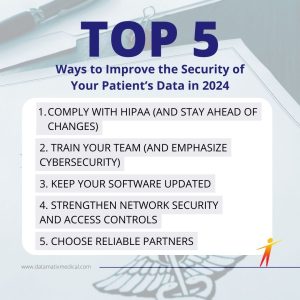
- Comply with HIPAA (and Stay Ahead of Changes)
- Train Your Team (And Emphasize Cybersecurity)
- Keep Your Software Updated (Including Cloud and AI Tools)
- Strengthen Network Security and Access Controls
- Choose Reliable Partners (And Vet Them Regularly)
Complying with HIPAA is the baseline, but more is needed in today’s cybersecurity environment. The HIPAA Security Rule remains essential, as it mandates the protection of electronic protected health information (ePHI) through administrative, physical, and technical safeguards.
However, it’s vital to stay ahead of changes. For instance, the 21st Century Cures Act has introduced new interoperability and data-sharing regulations that affect patient data security. Keeping your practice compliant involves regularly reviewing updates to HIPAA and related health IT regulations. Healthcare administrators should implement compliance audits and schedule regular HIPAA refresher courses to maintain compliance across all levels of their staff.
Tip: Consider adopting automated audit systems that track compliance and offer alerts when vulnerabilities or policy violations arise.
Train Your Team (And Emphasize Cybersecurity)
Training staff on HIPAA regulations has always been necessary, but modern threats like phishing attacks, ransomware, and credential theft require even more attention. Healthcare professionals should understand HIPAA EMR and recognize phishing attempts and potential security breaches. A staggering 88% of healthcare ransomware attacks are caused by phishing.
Tip: Provide annual cybersecurity training with real-world simulations on handling phishing emails, maintaining secure passwords, and reacting swiftly in case of a data breach. It would help if you also educated your staff on the significance of multi-factor authentication (MFA), which is increasingly vital for securing access to sensitive information.
Keep Your Software Updated (Including Cloud and AI Tools)
While updating your EHR software remains essential, the rise of cloud-based EHR systems and the integration of AI-driven tools have become game-changers for healthcare practices. Keeping software up to date includes ensuring that cloud vendors and AI tools meet NIST cybersecurity standards and provide end-to-end encryption for all data transfers.
The recent Dragon Medical One outage, linked to third-party issues involving CrowdStrike, highlights the importance of vetting vendors. When outsourcing, it’s critical to evaluate the security protocols of third-party partners. Poor third-party security could expose your practice to vulnerabilities beyond your control.
New Tip: Regularly review vendor security certifications and assess whether cloud solutions better suit your practice. Cloud solutions offer scalable security updates and protections without needing on-premise management.
Strengthen Network Security and Access Controls
As technology evolves, so do the ways cybercriminals infiltrate systems. Implementing robust network security protocols is a critical step in protecting patient data. In addition to establishing levels of access, practices should enforce the use of multi-factor authentication and encrypted connections for all employees accessing EHR systems.
According to the Healthcare Cybersecurity Industry Guide, ransomware attacks on healthcare systems increased by 22% in 2023. Implementing zero-trust architecture, where each access point is considered a potential threat until proven secure, is becoming a best practice.
New Tip: Incorporate AI-driven threat detection tools that monitor real-time network activity for suspicious behavior and notify your IT team of anomalies.
Choose Reliable Partners (And Vet Them Regularly)
The healthcare industry increasingly relies on third-party providers to manage EHR, cloud hosting, and cybersecurity. Outsourcing, when done right, can improve operational efficiency and security. However, as seen in the Microsoft and CrowdStrike issue, relying on third-party vendors can also introduce risks.
Medical practices must thoroughly vet their partners and maintain stringent service level agreements (SLAs) that require adherence to the highest cybersecurity standards. Ensure your partners meet SOC 2 and ISO 27001 compliance standards and benchmarks for secure data handling. This is not to be too promotional, but this is when a company like DataMatrix uses your system and not a helpful third party, decreasing the risk. If your network is secure, activities like transcription and authorizations in your EHR will be safe.
Tip: Regularly audit your third-party vendors’ compliance with security standards and insist on transparent incident response protocols in case of breaches.
Patient data security remains a top concern for healthcare practices. To avoid cyber threats, medical professionals must ensure compliance with HIPAA and evolving healthcare regulations, train their staff regularly, and maintain vigilance over software, network, and vendor security. By implementing these updated practices, your practice can better secure patient information and reduce the risk of costly data breaches.
For more insights, learn how DataMatrix Medical can help your practice comply with patient data security standards and optimize operations through secure and compliant medical transcription services.
Other References Used: 5 Ways to Improve the Security of your Business – Techerati.

Nathaniel Smathers is the VP of Client Education and Marketing. He is also a long time contributor of the DataMatrix Medical blog and has a background in healthcare content creation for over a decade. Nathaniel is passionate about exploring the intersections of healthcare, data analysis, and digital innovation.