How well are your physicians operating within your electronic health records (EHR)? With the increasing number of practices adopting some form of EHR software, your practice has likely experienced at least one, and possibly multiple, types of EHR.
Your physicians may have some mixed feelings about EHR, and for good reason. EHR can be difficult to operate if you don’t have the time, training, and experience to use the software properly.
If your practice is struggling with EHR, you’re not alone! Many practices experience difficulties with their electronic health records. However, more practice managers are beginning to realize the benefits of blending a medical transcription service within their EHR.
Throughout this blog, we will cover the basics of blending EHR medical transcriptions, including EHR obstacles, the integration process, and the benefits of seamless integration.
Potential EHR Complications
To get started, ask yourself the following questions regarding EHR usage:
- Are your physicians complaining about your current EHR software?
- Is your EHR taking up valuable physician time?
- Do your documents need to be re-edited to check for errors?
- Is the patient-provider relationship being negatively impacted due to EHR documentation?
- Is EHR impacting billing and payment reimbursement?
If you answered yes to any or all of these questions, your practice could benefit from blending your EHR with a medical transcription service.
If your physicians are struggling with EHR, or EHR is impacting your productivity, it’s time to reevaluate. There are numerous ways to enhance your EHR’s functionality for your practice; however, it’s not always easy to customize your EHR independently. This is when it pays off to invest in and reap the benefits of a medical transcription service.
7 Benefits of Blending EHR with Medical Transcription
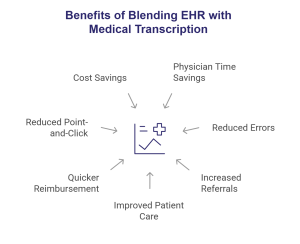
The benefits of a blended approach to EHR are hard to deny. Here are seven of the main ways your practice can improve by integrating a medical transcription service with your EHR:
1. Extra time for your physicians
When a patient discusses their symptoms, treatments, and medical details, it can be challenging to keep up, regardless of your skill level with EHRs. However, when your physicians are using digital dictation, a medical transcription service can transcribe what is being said directly into your EHR.
This allows your physicians to focus more on the patient rather than on a computer screen, making the patient feel heard, which is crucial to overall patient satisfaction.
2. Lower risk of document error
Outsourcing your electronic health records to a skilled transcriptionist will also reduce patient document errors. More often than not, your physician is typing so quickly that they make a few mistakes or errors within the documentation.
Not only are these errors time-consuming to fix, but they can also lead to more significant ethical issues if not detected in a timely manner. However, having someone transcribe this information for you results in more accurate documentation and fewer errors.
3. Increased referrals between physicians
When your EHR is blended with a medical transcription service, you may notice increased referrals between physicians. When used correctly, EHR makes it easier to share patient information between practices. This is especially helpful when a patient requires a specialized method of care.
When a medical transcriptionist is working with your EHR, documents will be easier to understand and navigate. This makes the referral process that much simpler, which not only improves the relationship between providers but also the patient-provider relationship.
4. Improved overall patient care
Every practice works to improve patient care. Blending EHR and medical transcription allows you to do just that!
Better and more accurate documentation is key to improving patient care. When documentation is entirely accurate, your physicians will have a better understanding of the patient’s care needs and can treat them accordingly.
Digital dictation also plays a role in patient care. When physicians outsource their dictations to a medical transcription service, they can spend quality face-to-face time with patients. This one-on-one interaction improves patient satisfaction, which in turn improves overall patient care.
5. Ability to make quicker reimbursement
Reimbursement for care is an issue for almost every practice. However, integrating EHR and medical transcription can help with that. When you have more accurate records, you will have more accurate billing.
This improved accuracy in billing enables your practice to seek reimbursement more quickly, resulting in less time for delayed or missed payments. Faster reimbursement also plays a role in patient care. When you have more funds to grow your practice, purchase new equipment, and more, you can invest more heavily in improving patient care.
6. Reduces point-and-click work for physicians
Within EHR, there are multiple buttons to click and boxes to check. Since physicians are already crunched for time, they may check boxes and click buttons they shouldn’t—resulting in larger, sometimes more serious, issues.
Blending EHR and medical transcription takes care of the point-and-click work physicians deal with, therefore reducing potential errors. This helps to improve patient information and overall EHR usage.
7. Saves your practice money
Integrating your medical transcriptions into Ean HR, or even Ean MR, is actually more affordable than you may think! As with any service, outsourcing your EHR can help your practice save money.
You won’t have to spend as much on dictation or medical transcription, and with the time your physicians are saving, your practice will be able to see more patients. After all, more patients equal more revenue for your practice. It’s a win-win for everyone!
Curious about more ways to save your practice money? Take a moment to read our blog,
11 Ways To Save Your Medical Practice Money.
It’s easy to see that a blended approach to EHR has multiple benefits. However, these benefits won’t be of much use to you without the right partner!
The DataMatrix Difference: Seamless Integration
When your practice is searching for the right medical transcription company to partner with their EHR, look no further than DataMatrix Medical. At DataMatrix Medical, we can seamlessly integrate into any EHR software. This not only guarantees the benefits above, but so much more.
When you outsource your medical transcriptions to us, you receive a team of highly skilled and trained medical transcriptionists handling all of your dictations and inputting them directly into forms within your EHR.
Our transcriptionists are trained to detect multiple dialects, speeds, and tones as well as understand medical terms, nuances, and jargon. This gives your transcriptions a human touch while making them increasingly accurate. Our expertise extends to providing medical transcriptions for any EHR.
Want to know how we do it? Take a look at our three-step integration process below!
Our Three-Step Integration Process
Step 1: Dictate your notes as usual.
To dictate your notes, you can use a traditional phone system, a voice recorder, or our convenient app.
Step 2: Submit dictations to our team of transcriptionists.
Our team will work quickly and accurately to transcribe your medical documents. We guarantee your transcriptions will be in your EHR within 24 hours!
Step 3: Data is entered into your EHR based on your preferences.
We want to make EHR work for your practice, which is why we offer fully customizable options. Your preferences are important to us, so we will ensure that data is entered in the way you prefer most.
And that’s it! It’s that easy to integrate your EHR with our medical transcription solutions. We understand the impact our services can have on your practice, offering seamless medical transcriptions for EMRs, which is why we provide a complimentary two-week trial to help get your practice started.

Nathaniel Smathers is the VP of Client Education and Marketing. He is also a long time contributor of the DataMatrix Medical blog and has a background in healthcare content creation for over a decade. Nathaniel is passionate about exploring the intersections of healthcare, data analysis, and digital innovation.