
Wegovy (semaglutide), developed by Novo Nordisk, has become a vital medication in managing obesity. Yet, securing prior authorization (PA) approval from insurers remains a critical barrier. This article examines the Wegovy prior authorization process, typical timelines, challenges faced by medical practices, and strategies for leveraging DataMatrix Medical’s expertise to streamline the approval process.
Before we discuss the workflow, let’s address a common source of confusion: isn’t Wegovy essentially the same as Ozempic or even Zepbound? Not quite. Think of them as close cousins—similar genetics but very different personalities at the insurance counter. Understanding these nuances is key to crafting successful authorization requests.
What’s the Difference between Wegovy and Zepbound
Wegovy and Zepbound are both medications approved for chronic weight management, but they differ in active ingredients, mechanisms, and insurance pathways:
- Wegovy contains semaglutide, a GLP-1 receptor agonist that helps regulate appetite and food intake. It is a higher-dose version of the same compound used in Ozempic. Still, it is FDA-approved specifically for obesity, resulting in more focused prior authorization criteria that emphasize BMI and comorbidity requirements.
- Zepbound contains tirzepatide, which targets both GLP-1 and GIP receptors. This dual action may result in more pronounced weight loss, but it also introduces a new drug profile. Because of this, insurers often apply stricter prior authorization requirements for Zepbound, sometimes including step therapy (e.g., requiring failure of Wegovy first) or more extensive documentation of past treatment attempts.
In practice, providers may find that Wegovy has a more established approval pathway, while Zepbound, being newer and more costly, can face more complex or inconsistent payer scrutiny.
Prior Authorization Basics for Wegovy
Prior authorization is a necessary checkpoint insurers use to verify the medical necessity and appropriateness of prescribed medications. Medical practices that prescribe Wegovy, including endocrinologists, obesity specialists, and primary care providers, frequently encounter detailed documentation requirements designed to substantiate the necessity of the medication.
Criteria Required for Wegovy Authorization
Practices typically need to document:
- BMI Criteria: ≥30 kg/m² or ≥27 kg/m² with related conditions (diabetes, hypertension, dyslipidemia).
- Lifestyle and Diet Programs: Evidence of patient participation in structured, monitored weight-loss programs.
- For example, a patient who has expressed a desire to lose weight but has not enrolled in a supervised nutrition or fitness program would likely not qualify for Wegovy. In one real-world case, a primary care practice submitted a prior authorization request for a patient with a BMI over 30 but lacking any history of formal lifestyle intervention. The payer rejected the request, requiring proof of at least 6 months of documented participation in a behavioral weight loss program. Without this documentation, the patient was deemed ineligible despite meeting other clinical criteria.
- Previous Treatment History: Comprehensive documentation of previously attempted interventions, outlining their limitations or failures.
- Clinical Rationale: Patient-specific justifications highlighting Wegovy’s unique benefits, such as superior weight reduction and lower adverse effect profiles compared to alternative medications.
How Long Does Wegovy Prior Authorization Typically Take?
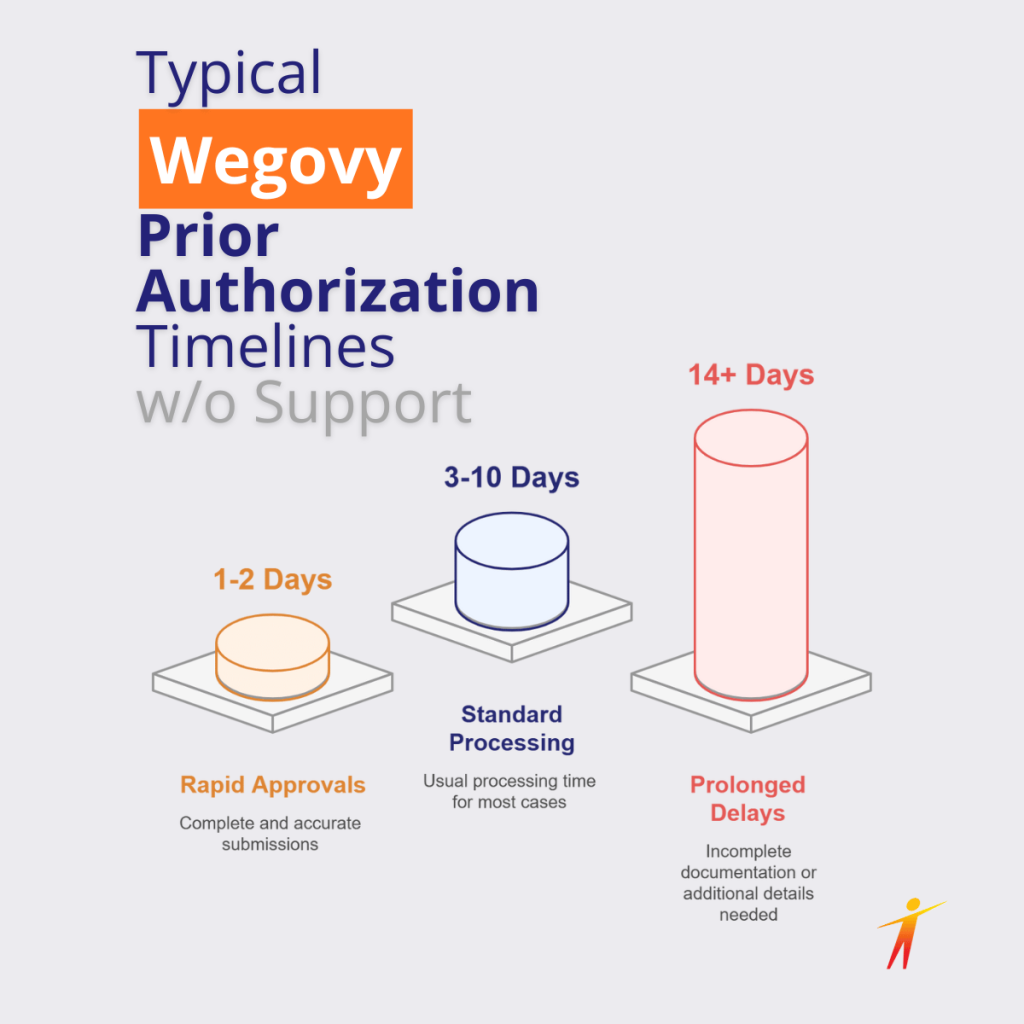
Approval timelines vary significantly, influenced by insurer policies, case complexity, and submission accuracy:
- Rapid Approvals: Typically within 1-2 business days when submissions are complete and accurate.
- Standard Processing: Usually takes 3-10 business days.
- Prolonged Delays: May extend several weeks if documentation is incomplete or if additional patient-specific details are required.
📝 DataMatrix Medical’s extensive industry relationships and expertise can cut typical authorization times by approximately 30-50%, provided initial documentation is accurate and comprehensive.
Challenges Practices Face in Wegovy Authorization
Practices commonly encounter hurdles such as:
- Documentation Errors: Even minor omissions can lead to denials. Recently, an endocrinology practice faced a denial due to insufficient documentation on a patient’s lifestyle modification attempts, requiring time-consuming resubmission and delaying treatment by nearly three weeks.
- Varying Insurer Criteria: Insurers differ significantly in their documentation requirements. For example, one insurer may require detailed diet history documentation, while another focuses primarily on clinical measures, such as BMI or blood pressure.
- Elevated Denial Rates: Studies report denial rates for Wegovy as high as 60%, primarily due to documentation shortcomings or insurer-specific procedural nuances.
Optimizing Prior Authorization with DataMatrix Medical
DataMatrix Medical assists medical practices by:
- Precision Documentation: Achieving over 99% accuracy in submissions, significantly reducing denial rates.
- Accelerated Approval: Efficient processes significantly reduce typical approval times.
- Seamless EHR Integration: Complete compatibility with existing Electronic Health Record systems.
- Consistent High Approval Rates: Maintaining a denial rate below 1%.
Conclusion
Although obtaining prior authorization for Wegovy presents substantial challenges, partnering with an experienced facilitator like DataMatrix Medical transforms the authorization landscape, ensuring timely patient care and reduced administrative burdens. Reach out today to optimize your practice’s prior authorization workflow.

Nathaniel Smathers is the VP of Client Education and Marketing. He is also a long time contributor of the DataMatrix Medical blog and has a background in healthcare content creation for over a decade. Nathaniel is passionate about exploring the intersections of healthcare, data analysis, and digital innovation.