Transitioning to a new Electronic Health Record (EHR) system is one of the most disruptive and necessary events a medical practice can experience. It doesn’t matter if you are transitioning to Athena, ModMed, Epic, or others; the challenges exist. Whether this is driven by regulatory compliance, a need for better functionality, or dissatisfaction with a current vendor, changing EHR systems introduces a cascade of changes that impact clinical workflows, administrative efficiency, finances, and patient care.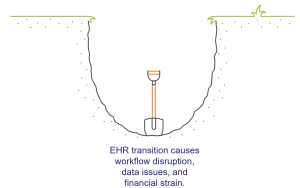
The good news? You don’t have to dig out on your own.
In this article, we’ll explore the most common challenges practices face during an EHR transition and how thoughtful EHR integration support can help overcome them. If you’re preparing for a transition or in the midst of one, this guide offers practical insight into keeping your practice stable and your team focused on what matters most: your patients.
Don’t want to read the entire article? Download our infographic that outlines the challenges of EHR implementation and how a BPO company like us can help make the experience much easier.
Challenge 1: Workflow Disruption
A new EHR inevitably means new ways of doing things, from how physicians document visits to how front-desk staff schedule appointments, workflows that once felt second nature may suddenly feel foreign. It can take months for a team to regain its footing. To avoid bottlenecks and errors, practices increasingly rely on virtual support staff to maintain continuity across critical administrative functions.
✅ EHR Integration Support Tip: Implementing support staff like medical scribes during the transition can help maintain continuity. Experienced scribes can document visits directly into the new system while providers adapt, ensuring patient visits remain efficient and documentation accurate.
In addition to scribing, virtual support staff can assist with essential administrative functions such as managing prior authorizations, scanning documents into the new system, and verifying insurance details.
This remote support reduces the burden on in-house teams and allows clinical staff to focus on patient care rather than getting bogged down in clerical adjustments.
Challenge 2: Data Migration Headaches
Migrating data from one EHR to another is rarely as clean as we hope. Imagine this: a practice completes its transition to a new EHR and discovers that a significant portion of its historical allergy data is missing or mismatched.
Picture this: One patient, previously flagged as allergic to penicillin, no longer has that alert in their record. The provider, unaware of this omission, prescribes a common antibiotic, triggering a near-miss event. Structured data like allergies, medications, and lab results may not transfer correctly if data mapping isn’t precisely configured.
Legacy records can be left behind and inaccessible in day-to-day patient care. And when fields don’t align—say, past surgical history landing in the social history tab—it can create confusion or lead to critical oversights.
These headaches are more than inconveniences; they can compromise patient safety and provider trust in the system.
✅ EHR Integration Support Tip: While data migration is often handled by EHR vendors, having an administrative support team to help audit patient charts, validate fields, and verify critical information can reduce the risk of clinical errors. This secondary layer of oversight helps avoid future headaches for providers and patients.
Challenge 3: Training and User Adoption
Training staff on a new EHR is essential but time-consuming. The learning curve can impact morale and productivity, especially when training is layered on top of a full workday.
✅ EHR Integration Support Tip: Outsourcing administrative tasks or documentation during go-live gives your in-house staff more time to focus on training. Medical scribes, intake coordinators, or back-office support can help absorb overflow during this critical learning period.
Challenge 4: Financial Strain and Revenue Disruption
EHR transitions can slow down patient volume and increase the risk of billing delays. Practices often experience a dip in revenue in the early phases of implementation.
Picture this: A busy multi-specialty clinic that normally sees 80 patients a day. During their EHR transition, appointment capacity drops to 60 patients due to longer documentation times and uncertain workflows. Over a month, that’s 400 fewer visits, amounting to tens of thousands of dollars in lost revenue.
Meanwhile, coding errors spike as providers struggle with new templates, resulting in delayed reimbursements and rejected claims. On top of that, the administrative team is overwhelmed, juggling their usual workload while learning a new system, further slowing down processes like billing, prior authorizations, and claims resubmissions.
These disruptions add up quickly, creating financial pressure just when the practice is investing heavily in technology and training.
✅ EHR Integration Support Tip: During the transition, support your practice with pre-authorization experts and claims-ready documentation to ensure that the billing cycle stays intact. Prior authorization services tailored to your new EHR help prevent claim interruptions while your team gets comfortable with new processes.
Challenge 5: Interoperability and System Integration
Practices rarely use their EHR in a vacuum. Imagine a busy cardiology group whose new EHR doesn’t seamlessly communicate with the third-party lab system they rely on. A provider orders a stat blood test, but the order doesn’t transmit correctly due to a lack of integration. The lab never receives it, delaying care and frustrating the patient and the provider.
This isn’t just hypothetical—it’s a common scenario during EHR transitions. Labs, pharmacies, billing vendors, and diagnostic tools all need to connect to the EHR to ensure patient care flows smoothly. When these systems can’t speak the same language, it results in duplicate work, missed information, and critical communication breakdowns.
The interconnectedness of modern medical practices makes true interoperability not just a luxury but a necessity.
✅ EHR Integration Support Tip: Working with an experienced support team that understands how to document within multiple EHRs and interface with outside systems reduces errors and delays. BPO teams can help practices troubleshoot process gaps while maintaining operational flow.
Challenge 6: Patient Experience Disruptions
 Patients may be unaware of what’s happening behind the scenes, but they can quickly feel the effects of an EHR transition. Take, for instance, an orthopedic practice that recently switched systems.
Picture this: A returning patient arrives expecting a seamless check-in for a follow-up on a knee injury. Instead, their intake form isn’t available, prior imaging hasn’t been transferred correctly, and they’re asked to re-describe their injury history. The wait time stretches beyond what’s normal as staff scramble to track down missing information.
The patient leaves frustrated, not because of the quality of care, but because the experience felt disorganized and impersonal.
These moments chip away at trust and loyalty, especially when patients are dealing with chronic or painful conditions and expect consistency from their providers.
✅ EHR Integration Support Tip: Support services that handle scheduling, appointment reminders, and follow-ups can relieve front desk staff and help patients feel more attended to. At the same time, documentation support keeps visit notes timely and accurate, reducing the downstream effects of poor communication.
Challenge 7: Team Morale and Burnout
Change is hard, especially when it affects every aspect of a person’s job. EHR transitions can be a source of tension and fatigue for medical assistants, nurses, physicians, and administrative staff.
✅ EHR Integration Support Tip: Outsourcing high-effort, non-clinical tasks during this period can prevent burnout. Delegating pre-charting, medical transcription, or referral management responsibilities ensures your staff can focus on the most meaningful parts of their role.
Proactive EHR Integration Support Makes All the Difference
While a new EHR promises better data, faster workflows, and improved compliance, it can also introduce chaos if not carefully managed. Practices that successfully navigate the transition often rely on a thoughtful mix of technology and people-powered support.
By partnering with experienced EHR integration support teams or implementing processes that fill the gaps, practices can maintain consistency, reduce risk, and ease the strain on in-house staff. Whether leveraging medical scribes to support documentation or bringing in administrative professionals to keep operations flowing, support services help bridge the gap between disruption and stability.
Remember, your clinical staff should be focused on patient care, not troubleshooting dropdown menus. With the right help, your practice can emerge from an EHR transition not only intact but also stronger.
Final Thoughts
An EHR change doesn’t have to feel like navigating a storm without a compass. With proactive EHR integration support, your practice can stay on course, avoid the most common pitfalls, and realize the full value of your new system faster.
Whether you’re weeks away from go-live or still assessing your options, consider how additional hands trained in healthcare operations can help you lead your team through a smoother, smarter EHR transition.

Nathaniel Smathers is the VP of Client Education and Marketing. He is also a long time contributor of the DataMatrix Medical blog and has a background in healthcare content creation for over a decade. Nathaniel is passionate about exploring the intersections of healthcare, data analysis, and digital innovation.