Medical coding is a crucial part of every practice. After all, without it, insurance companies would be unable to reimburse, reduce, or approve claims.
However, when these codes are misentered or miscoded, it can cause serious implications for your practice and its patients.
Below, we dig a little deeper into the world of medical coding to discuss:
- The importance of accurate medical coding
- The complexity involved in proper medical coding and coding education
- The potential implications of miscoding
- The benefits of outsourcing your medical coding
Please continue reading or listening to the rest of the article on YouTube
The Importance of Accurate Medical Coding
Accurate medical coding is key to receiving reimbursement from an insurance company and to maintaining proper patient documentation. If a code is incorrect, the insurance company may deny a claim that would otherwise have been approved. The denial of an insurance claim (regarding improper coding) is usually a result of two common types of improper coding: under-coding and over-coding.
Under-coding occurs when your practice isn’t reimbursed as much as it should have been due to miscoding. When something is under-coded, your practice actually loses money.
Over-coding, on the other hand, asks the insurance company to pay more than what is actually needed. This miscoding could be considered fraud by your practice and may result in serious legal or financial penalties.
This is why accurate medical coding is so important. When coding is incorrect, your practice and its patients suffer. While miscoding can seriously impact your practice’s finances, it also directly impacts patient documentation.
For example, if a patient has a knee injury and needs to be referred to a specialist, the correct codes must be entered so the specialist can properly identify and treat the affected knee. A slight coding error may indicate that the injured knee is on the left leg rather than the right, resulting in incorrect patient care. Mistakes like this are easy to make; however, they can have serious consequences for your practice and the patient experience.
The Complexity of Medical Coding Training and Education
Unfortunately, coding slip-ups are common due to a lack of proper training and education. Many practices don’t have time to stay up to date on coding changes, leading to unintentional miscoding.
Diagnosis-Related Groups (DRGs) are typically the most difficult to code. DRGs consist of patient diagnoses, procedures, complications, symptoms, age, gender, and pre-existing conditions. All of these are necessary to properly identify a patient, which is why whoever is in charge of insurance claims at your practice needs to know how to code correctly.
Coding is typically updated once a year, so your practice needs to stay aware of the changes and communicate them effectively to your staff. If staff are unaware of coding changes, your practice is more likely to experience the negative effects of miscoding.
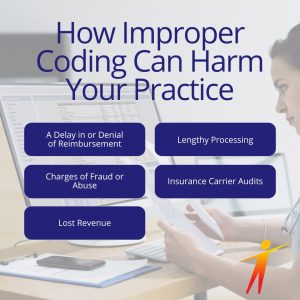
How Improper Coding Can Harm Your Practice
There are several ways in which failing to provide correct coding can harm your practice. Here are some of the most notable consequences of miscoding:
A Delay in or Denial of Reimbursement
As we mentioned earlier, under- and overcoding can result in being reimbursed too much, too little, or not at all. When coding is incorrect, it’s unlikely that your practice will be reimbursed for the amount it needs. This financial impact can strain your practice and lead to lost time due to the need to correct and resubmit the codes.
According to the American Medical Association (AMA), 20% of medical claims are denied on the first submission due to coding errors, resulting in delayed payments.
Lengthy Processing
It takes enough time to submit the claim as is. However, when you have to locate your mistake, correct it, and resubmit a claim due to miscoding, your practice is losing time it can’t afford to lose. This process can take a while, which in turn can further delay reimbursement.
Charges of Fraud or Abuse
If your insurance provider suspects fraud or abuse due to over-coding, your practice may be fined. These fines can be quite expensive, yet so easy to avoid with proper coding. Working your way through or out of these fines can take time, not to mention the burden these inevitable costs will place on your practice.
Insurance Carrier Audits
Additionally, if your insurance carrier suspects fraud or abuse, they may audit your practice. They will take an in-depth look at your coding process, and could determine that your practice owes money.
When coding is correct, an action like this can be easily avoided—especially if you outsource your medical coding to an experienced company.
Lost Revenue
One of the most important reasons to create a tight process for accurate coding is the risk of revenue loss. At the end of the day, we want to create a good patient experience, but we are also a for-profit business with the cash-flow challenges that come with that.
A study by the Healthcare Financial Management Association (HFMA) found that coding errors can cost practices between 3% and 10% of their revenue, with some specialties experiencing even higher losses.
How To Improve Medical Coding Through Outsourcing
Outsourcing your medical coding can help save time in the office and reduce the risk of consequences from miscoding. The investment in a coding service is one worth making—especially when you partner with the team at DataMatrix Medical.
DataMatrix Medical’s Medical Coding Service
Here at DataMatrix Medical, we know that coding requires extensive time and effort, and medical coding is different than medical transcription. Any error, no matter how big or small, can cause serious implications for your practice.
When medical coding is accurate, your practice benefits from fewer errors, improved patient care, and a faster billing cycle (we can help with patient billing, too).
If your practice needs a streamlined coding audit and medical coding service you can rely on, we can help. Our team can review surgical claims and audit them against sourced documents to identify any lost revenue caused by improper coding.
Here’s how we do it here at DataMatrix Medical:
- You submit documentation either through dictation, operative reports, and/or handwritten charge tickets.
- We review the charges and codes for errors and then provide them in a standard format based on your requirements, right within your EHR.
Our process is simple and can help ease the pressure surrounding miscoding. To learn more about our coding solutions, contact us. We’ll be happy to answer any questions you have! Let us show you the value our services can bring to your practice.

Nathaniel Smathers is the VP of Client Education and Marketing. He is also a long time contributor of the DataMatrix Medical blog and has a background in healthcare content creation for over a decade. Nathaniel is passionate about exploring the intersections of healthcare, data analysis, and digital innovation.